
 All vikis
 007 First Light
 AI
 Aion 2
 Ananta
 ARC Raiders
 ArcheAge Chronicles
 Call of Duty: Modern Warfare 4
 Chrono Odyssey
 Civilization 3
 Civilization 4
 Claude
 Crimson Desert
 Deadlock
 Diablo 4
 Diablo 5
 Enshrouded
 Fable
 Final Fantasy Resonance
 Football Manager 27
 Forza Horizon 6
 God of War
 Grand Theft Auto 6
 Heroes of Might and Magic 3
Batch API
The OpenAI Batch API runs up to 50,000 requests from one file within 24 hours at 50% off the normal price. Flex processing gives the same discount on ordinary calls that can be slow, Fast mode costs double for quicker answers, and prompt caching cuts the price of repeated prompt prefixes.
The OpenAI Batch API takes a file of up to 50,000 requests, finishes them within 24 hours, and charges 50% less than the same calls made one by one. It is the simplest way to cut an OpenAI API bill in half for work nobody is waiting on: classifying a backlog, embedding documents, running evaluations, generating images in bulk. Three related options trade price against speed on ordinary calls: Flex processing (also half price, but slower and sometimes refused), Fast mode (double price, quicker), and Ultrafast (six times the price, for GPT-6 Astra and GPT-6.1 Sol only). Prompt caching lowers the price of any prompt that repeats a long prefix. All four are explained below, with prices as of Nov 6, 2026.
Quick facts
| Batch discount | 50% lower cost on input and output |
| Completion window | 24 hours, the only option |
| Batch size | Up to 50,000 requests, input file up to 200 MB |
| Batch creation | Up to 2,000 batches per hour |
| Flex | service_tier: "flex", Batch prices, beta |
| Fast (formerly Priority) | 2x Standard, renamed Jul 30, 2026 |
| Cache read on GPT-6.1 Sol and Terra | 0.05x input |
| Minimum cacheable prompt | 1,024 tokens |
How the Batch API works
- Write a JSONL file, one request per line, each with its own id, method and endpoint. Up to 50,000 requests and 200 MB (Batch guide).
- Upload the file to OpenAI.
- Create the batch, naming the endpoint and the
24hcompletion window. - Poll the batch until it completes, or come back later; results are guaranteed within 24 hours.
- Download the output file and match each result to its request by id.
The endpoints a batch can call, as of Nov 6, 2026: /v1/responses, /v1/chat/completions, /v1/embeddings, /v1/completions, /v1/moderations, /v1/images/generations and /v1/images/edits (Batch guide). Image models joined on Feb 10, 2026. Batches have their own queue limit, counted in input tokens queued per model, separate from the per-minute limits (rate limits guide); GPT-6 Astra's queue is 3M tokens on Build, 200M on Launch and 15B on Grow (GPT-6 Astra).
Batch prices for the flagship models
| Model | Standard (in / cached / out) | Batch (in / cached / out) |
|---|---|---|
| gpt-6-astra | $10.00 / $1.00 / $50.00 | $5.00 / $0.50 / $25.00 |
| gpt-6.1-sol | $2.00 / $0.10 / $10.00 | $1.00 / $0.05 / $5.00 |
| gpt-6.1-terra | $1.00 / $0.05 / $5.00 | $0.50 / $0.025 / $2.50 |
| gpt-6-luna | $0.10 / $0.01 / $0.50 | $0.05 / $0.005 / $0.25 |
Source: OpenAI API pricing, short context, per 1M tokens, read Nov 6, 2026.
Image models are half price in Batch too (GPT Image 2 image tokens $4.00 in, $15.00 out), but the pricing page lists no Batch row for the newest GPT-Image-2.6 models. See GPT Image.
Flex processing
Flex is for calls that can wait but do not fit a batch file. You make an ordinary Responses or Chat Completions call with service_tier: "flex" and pay Batch rates. The catch: responses are slower, and when capacity is short the API answers "429 Resource Unavailable", which is not charged. Flex is in beta. On the older models it is offered for short context only, on gpt-5.4-mini, gpt-5.4-nano, gpt-5.2, gpt-5.1, gpt-5, gpt-5-mini, gpt-5-nano and o3 (pricing).
Batch or Flex? Use Batch when you have many requests at once and can wait up to a day. Use Flex when requests arrive one at a time and a slow or retried answer is acceptable, such as background jobs in an app.
Fast and Ultrafast
Fast mode is the opposite trade: twice the Standard price for "up to 2.5x faster speeds and more consistent latency", a figure OpenAI states for gpt-5.6-sol. It replaced Priority processing on Jul 30, 2026, and service_tier accepts either "fast" or "priority". Fast covers the GPT-5.6 models, GPT-6.1 Sol, GPT-6.1 Terra, GPT-6 Luna and GPT-6 Astra; Astra's Fast mode carries no latency SLA (Fast mode guide).
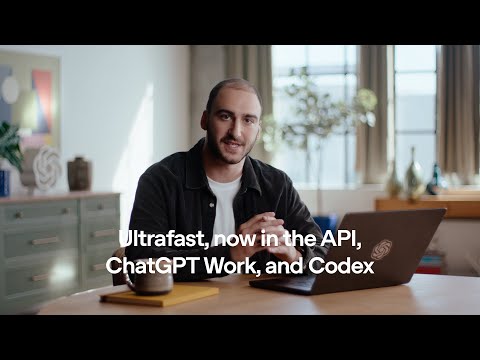
Ultrafast is offered only for GPT-6 Astra and GPT-6.1 Sol, at $60 / $300 and $12 / $60 per 1M input and output tokens, six times Standard. In OpenAI's Sep 29, 2026 Ultrafast video, GPT-6 Astra in Ultrafast generates tokens in the API "over seven times faster than standard tier" and over four times faster than Fast; Unite.AI's DevDay report put it at up to 6x faster (Unite.AI). These are OpenAI's speed claims; no independent latency measurement was found for this page.
Prompt caching
When a request starts with the same tokens as a recent one, OpenAI serves that prefix from cache at a much lower price (prompt caching guide, read Nov 6, 2026):
- Minimum: 1,024 tokens of prompt for GPT-5.6 and later.
- Cache reads: 0.1x the input price on GPT-5.6 and later, and 0.05x on GPT-6.1 Sol and GPT-6.1 Terra. OpenAI sums this up as "up to 95%" off.
- Cache writes: 1.25x the input price for the default 30-minute lifetime, 2.5x for the 12-hour lifetime (Responses API only, since Oct 20, 2026).
- Setting:
prompt_cache_options.ttl= "30m" or "12h". Older models useprompt_cache_retentionwithin_memory(typically 5 to 10 minutes, up to an hour) or24h; code moving from GPT-5.5 or earlier must switch to the new field (latest model guide). - Privacy: compatible with Zero Data Retention.
How to get more cache hits
- Put the parts that never change first: system instructions, tool definitions, long documents.
- Put the user's message and anything that varies last.
- Use the 12-hour cache only when a prefix will be reused across hours; its write costs twice the 30-minute write.
- Change reasoning effort with a
configuration_updateitem rather than a new request, so GPT-6 keeps the cache (latest model guide).
OpenAI added Prompt Cache Diagnostics on Sep 8, 2026 to show why a request missed the cache. Caching and Batch stack: batch cached input on GPT-6.1 Sol is $0.05 per 1M tokens.
Which option to pick
| Need | Use | Price vs Standard |
|---|---|---|
| Thousands of requests, results by tomorrow | Batch API | 0.5x |
| Background calls one at a time, can be slow | Flex | 0.5x |
| Normal interactive app | Standard | 1x |
| Faster, steadier answers | Fast | 2x |
| The fastest Astra or Sol | Ultrafast | 6x |
| Long repeated prompts | Prompt caching, with any of the above | Reads 0.05x to 0.1x input |
Source: OpenAI API pricing, read Nov 6, 2026.
All prices: OpenAI API Pricing. Limits per tier: API Rate Limits. Anthropic's Claude API offers the same 50% batch discount; see OpenAI API vs Claude API.
Frequently asked questions
How much does the OpenAI Batch API save? The OpenAI Batch API costs 50% less than standard calls on both input and output tokens; GPT-6.1 Sol, for example, drops from $2 and $10 to $1 and $5 per 1M tokens, as of Nov 6, 2026.
How long does an OpenAI batch take? OpenAI's Batch API completes each batch within a 24-hour window, the only window offered, so plan for results up to a day later.
What is Flex processing in the OpenAI API? Flex is a beta service tier, set with service_tier: "flex", that bills normal Responses or Chat Completions calls at Batch prices in exchange for slower answers and possible 429 errors, which are not charged.
What replaced OpenAI Priority processing? Fast mode replaced Priority processing on Jul 30, 2026. It costs twice the Standard price, and service_tier still accepts "priority" as well as "fast".
How does OpenAI prompt caching work? OpenAI caches prompt prefixes of at least 1,024 tokens; later requests that repeat the prefix pay 5% to 10% of the input price for it on GPT-5.6 and later models, after a write charged at 1.25x input for 30 minutes or 2.5x for 12 hours.
Sources
- Batch API, OpenAI, read Nov 6, 2026
- Flex processing, OpenAI, read Nov 6, 2026
- Fast mode, OpenAI, read Nov 6, 2026
- Prompt caching, OpenAI, read Nov 6, 2026
- Using the latest model, OpenAI, read Nov 6, 2026
- Pricing, OpenAI, read Nov 6, 2026
- Rate limits, OpenAI, read Nov 6, 2026
- GPT-6 Astra model page, OpenAI, read Nov 6, 2026
- Changelog, OpenAI, read Nov 6, 2026
- OpenAI unveils GPT-6.1 Sol at DevDay with new Codex and ChatGPT tools, Unite.AI, read Nov 6, 2026
- Build faster with Ultrafast, OpenAI, Sep 29, 2026 (video)
Moments
Build faster with Ultrafast
OpenAI
Related
-
 Apps SDKThe Apps SDK was OpenAI's 2025 toolkit for building apps inside ChatGPT on the Model Context Protocol (MCP). Since Jul 9, 2026 apps live inside plugins, and the Apps SDK documentation now opens OpenAI's Plugins docs, where you build an MCP server, optional UI and skills and submit them to the ChatGPT Directory.
- Fine-TuningOpenAI is winding down fine-tuning: the platform is closed to new users, new job creation was restricted on Jul 2, 2026, and existing customers lose job creation on Jan 6, 2027. Fine-tuned models keep serving until their base models are retired, and no GPT-6 model can be fine-tuned.
-
 Realtime APIThe OpenAI Realtime API streams speech in and speech out with low latency over WebRTC or WebSocket, using models such as gpt-realtime-2.1 and the full-duplex GPT-Live 1 ($0.05 a minute), as of Nov 6, 2026. It also handles live transcription and speech-to-speech translation.
-
 Responses APIThe Responses API is OpenAI's recommended endpoint for new projects, combining model calls, built-in tools, structured outputs and conversation state in one request. Chat Completions is still supported, and the Assistants API it replaced shut down on Aug 26, 2026.
-
-
 AGENTS.mdAGENTS.md is a plain Markdown file of instructions for AI coding agents, a "README for agents", that Codex reads before doing any work. Codex loads a global ~/.codex/AGENTS.md and then every AGENTS.md from the repository root down to the working folder, closest last, up to 32 KiB; /init writes a first one. The open format is now stewarded by the Agentic AI Foundation.
-
 CodexCodex is OpenAI's coding agent: it reads a codebase, edits files, runs commands and tests, reviews pull requests and works in the cloud. As of Nov 6, 2026 it lives inside the ChatGPT desktop app, in the Codex CLI, in IDE extensions, in Codex Cloud and on mobile, and every ChatGPT plan includes some of it, Free and Go too.
-
See also
-
 OpenAI APIThe OpenAI API lets programs call OpenAI's models (GPT-6 Astra, GPT-6.1 Sol, GPT-6.1 Terra, GPT-6 Luna, image, voice and transcription models) with an API key, billed per token. New projects use the Responses API through the official SDKs, with documentation at developers.openai.com.
-
-
 OpenAI API PricingOpenAI API prices are per 1M tokens: GPT-6 Astra costs $10 input and $50 output, GPT-6.1 Sol $2 and $10, GPT-6.1 Terra $1 and $5, and GPT-6 Luna $0.10 and $0.50, as of Nov 6, 2026. Batch and Flex halve those prices, Fast doubles them.
- API Rate LimitsOpenAI API rate limits depend on your usage tier (Free, Build, Launch or Grow), which rises automatically as total credit purchases reach $5, $100 and $500. On the Build tier GPT-6 Astra allows 5,000 requests and 1,000,000 tokens a minute, and going over returns HTTP 429.
-
 OpenAI API vs Claude APIThe OpenAI API and Anthropic's Claude API charge the same for their top models ($10 input, $50 output per 1M tokens for GPT-6 Astra and Claude Fable 5.1) and their cheapest ($0.10 and $0.50 for GPT-6 Luna and Claude Haiku 5.5), as of Nov 6, 2026. Claude leads the dated coding and text leaderboards and charges no long-context premium; OpenAI is the only one of the two with image, speech and realtime voice models.
-